The problem
Electrochemical models depend on how ions interact with electrode surfaces. Common model parameters can predict the wrong kind of ion adsorption.
What I did
Enhanced-sampling molecular dynamics calculated free-energy profiles for sodium, chloride, and fluoride at a gold–water interface. The authors compared classical force fields with UMA and incorporated adsorption into a continuum interface model.
What we found
- UMA predicted strong specific adsorption for chloride, weak adsorption for fluoride, and no specific adsorption for sodium.
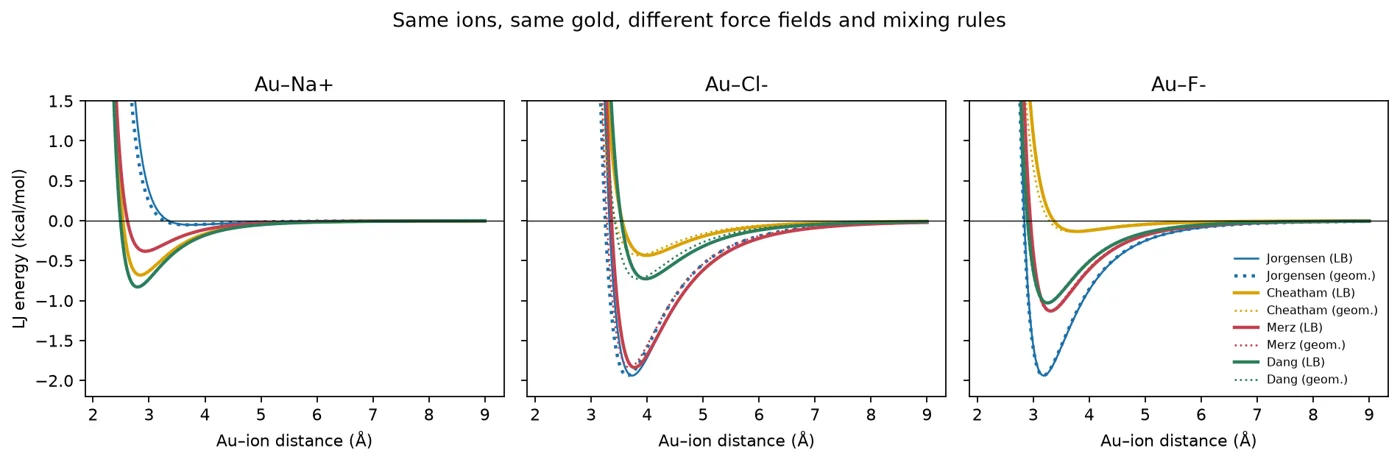
- Classical adsorption predictions changed substantially with the ion–gold Lennard-Jones cross parameters.
- The final fit adjusted both the well depth ε and the size parameter σ to approximate the UMA-S(OMat) free-energy profiles. The classical models still missed specific chloride adsorption.
- Including specific adsorption changed the predicted ion population, potential of zero charge, and differential capacitance.
Figures
Why it matters
The parameterization approach helps researchers choose ion–electrode models for electrochemical device simulations.
Recreate it yourself. Recompute the Au–ion Lennard-Jones cross terms for the four ion force fields in the paper’s Table I, and see how far they disagree. Open the tutorial →
Next case study · Intermediate nickel lowers shear stress in sputtered MoS₂ → · Back to Electrochemical interfaces research